

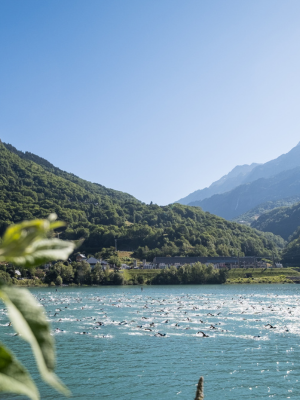
The Alpe d’Huez Triathlon swim takes place in an exceptional setting. The Lac du Verney, at an altitude of 725 metres, lies in the heart of the Oisans valley, in an intimidating mountain enclave. This artificial lake serves as the lower reservoir of the EDF Grand’Maison hydroelectric power station, the most powerful in France. The Verney is off-limits to swimmers because of the risks associated with EDF’s industrial activity, but triathletes have access to it for the duration of the races. To ensure the safety of the swimmers, the Grand’Maison power station is exceptionally shut down that week. But do the participants realise that this playground has a key role in the energy transition?
Without any doubt, being able to swim in the Lac du Verney for the last 17 years is a privilege and a sine qua non for the organisation of the Alpe d’Huez Triathlon and for its participants. It’s easy to forget, but just a few metres from the start and the transition park, the EDF Grand’Maison power station is capable of delivering, without CO2 emissions, energy equivalent to that of two nuclear reactors. What’s more, this energy (1800 MW) can be mobilised in three minutes, to meet peaks in consumption and compensate for the intermittent nature of the new renewable energies, whose production is affected by variations in wind and sun.

This last function makes the entire infrastructure of the Grand’Maison hydroelectric power station (its upper reservoir 900 metres above sea level, its turbines, the Lac du Verney) absolutely essential to the energy transition and the balance of the French electricity grid. Hydroelectricity is currently the only means of storing electricity on a large scale, and the primary purpose of pumped storage stations (‘STEP’ in French) is to build up electricity reserves by storing large volumes of water at altitude: a real battery, with a record capacity. Through the Grand’Maison power station and the Lac du Verney, EDF is supporting the participants in the Alpe d’Huez Triathlon in their athletic adventure, but more importantly, in their everyday lives.
An unprecedented project at the Grand'Maison hydroelectric power station
This has never happened since it was built in 1987! Reversible generating unit no. 1 is undergoing a complete overhaul. This 20-month project is coming to an end this season. The aim of this monumental operation? To carry out a meticulous technical inspection of every part of the No. 1 production unit. It was a ‘Pharaonic’ operation: generating unit no. 1 was completely dismantled for the occasion, and its impressive turbine is almost 20 metres high, weighs 300 tonnes and produces 150 MW. For this colossal project, 7,500 hours of work were required to ensure a total refurbishment. Technical feats are not just for triathletes!