

The Alpe d’Huez Triathlon swim is held in an exceptional setting. The Lac du Verney, at an altitude of 725 metres, is located in the heart of the Oisans valley, in an intimidating mountain enclave. This artificial water dam serves as the lower reservoir of the EDF Grand’Maison hydroelectric power station, the most powerful in France and Europe, whose production is stopped each year to allow the triathletes to swim in its crystal clear waters. But do the participants have any idea that this sports arena plays a major role in the energy transition?
Without a doubt, being able to swim in the Lac du Verney for the past 15 years is a privilege and a sine qua non for the organisation of the Alpe d’Huez Triathlon and for its participants. It is easy to forget, but a few meters from the start and the transition park, the EDF power plant of Grand’Maison is able to deliver, without CO2 emissions, an energy equivalent to that of two nuclear reactors. Above all, this energy (1800 MW) can be deployed in three minutes to meet peak consumption and compensate for the intermittence of new renewable energies whose production is altered by variations in wind and sun.
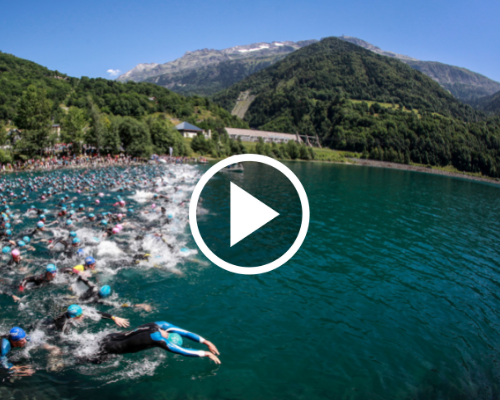
This last function makes all the hydroelectric infrastructures of the Grand’Maison power station (its upper reservoir 900 metres above, its turbines, the Lac du Verney) absolutely essential to the energy transition and to the balance of the French electricity network. Hydroelectricity is currently the only means of large-scale electricity storage, and the primary purpose of pumped storage stations (PSS) is to build up electricity reserves by storing large volumes of water at altitude: a real battery with a record capacity. Through the Grand’Maison power station and the Lac du Verney, EDF is accompanying the participants of the Alpe d’Huez Triathlon in their epic journey, but more importantly, in their daily lives.