
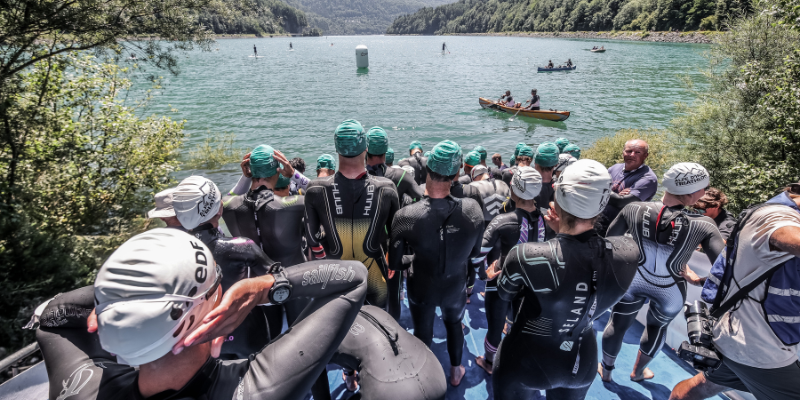
Since it was first held, the Alpe d’Huez Triathlon has been able to count on a partner that is essential to the running of the events: EDF. Thanks to EDF’s involvement, the swimming events can be held in the exceptional setting of Verney lake. Three questions to Jérôme Excoffier, head of the Grand’Maison hydroelectric power station, the most powerful in France.

Swimming in the reservoir of a hydroelectric dam is not a matter of course, as this type of body of water is strictly forbidden for bathing. How does EDF manage an event like the Alpe d’Huez Triathlon?
“EDF has been a partner of the Alpe d’Huez Triathlon since the first edition of the event because, without this collaboration, the swimming part could not take place in the Verney lake. So that the athletes can swim in good conditions, we have to anticipate the complete shutdown of the two power stations at Le Verney and Grand’Maison in order to stabilise the lake level and avoid any water movement during the event. We are therefore suspending all our programmes for an entire morning, which represents a major technical and financial effort for EDF, as the two power stations, particularly Grand’Maison, account for a significant proportion of electricity production on the network. The shutdown requires a great deal of preparation, as production has to be shifted to other facilities for the duration of the triathlon.”
How is EDF staff involved during the event?
“We make EDF equipment and personnel available to the organisers. A boat and a pilot are mobilised to transport the medical team on the water throughout the swimming event. We also provide access to the land around Verney lake for the bike park, the start area, the public and vehicle parking. As the employees and their families live within this perimeter, we ask competitors to respect the area, whether it’s for parking or rubbish. In addition, at the time of the swimming event, the staff present at Le Verney are extremely vigilant because they have to ensure that the power station remains at a standstill. However, managing this type of situation is part of our job, so the day of the triathlon is almost like any other working day for us… even if the staff really enjoy watching the event from the power station management building!”
What are the characteristics of the Verney lake?
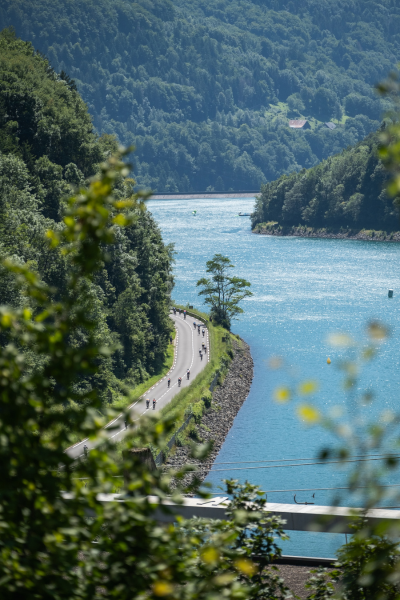
“The Verney hydroelectric power station is the historic power station that still operates today and sends 63,000 volts to the grid. It’s a very small power station, especially compared with Grand’Maison, which is the biggest pumped storage power station in Europe and sends 4,000,000 volts to the grid. During the triathlon, everything is completely shut down. Only natural inflows are restored. We cannot interrupt the flow of the Eau d’Olle, but this flow is marginal and has no influence on the level of the reservoir. On the other hand, there is still a natural current that the triathlon competitors probably feel. The Verney reservoir contains 14 million cubic metres and the water temperature fluctuates between 14 and 16°C in July. It’s cool because the water comes from the Grand’Maison dam, which is itself situated at an altitude of 1,700 metres and is fed in part by glacial meltwater from the Oisans massif. Under normal circumstances, the Verney is strictly closed to swimming. The triathlon therefore benefits from exceptional conditions.”