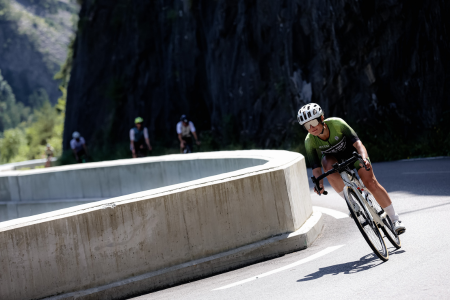
Now it’s time to get going. If you’re registered for the 2026 Alpe d’Huez Triathlon, you have just six months left to prepare to take on the legend. Perfect timing: our partner, the iDO Sport App, is offering a six-month plan specially crafted by our two My Tribe partners, Charlotte Morel and Frédéric Belaubre. To whet your appetite, they’re sharing five training ideas for the coming months. Warning: it’s going to hurt!
SESSION 1
BASE ENDURANCE
Duration: 2–2.5 hours
Route: Hilly course with 500–800 m of elevation gain
Intensity: Zone 2 (conversational) – 65–75% max heart rate
Focus: Cadence work on gentle inclines
Goal: Develop your aerobic capacity and muscular endurance on hilly terrain. This session forms the foundation of your training by getting your body used to long efforts at moderate intensity.
Execution Tips: Maintain a smooth cadence of 85–95 rpm. Stay well hydrated (1 bottle/hour). On slight inclines, alternate 2–3 minutes at 95–100 rpm to work on cadence, then return to your normal rhythm. Eat regularly (30–60 g of carbohydrates/hour). Focus on your position and keep your shoulders relaxed.
Perceived Intensity: Comfortable effort where you can hold a full conversation. Breathing is steady, legs turning without burning. You should be able to maintain this pace for several hours. Slight muscular fatigue at the end of the ride is normal, but exhaustion is not.
Detailed Breakdown
0–15 min: Very gradual start, joint warm-up
15–120 min: Steady Zone 2 pace, include 6–8 cadence sequences (2–3 min each) on slight inclines
120–150 min: Maintain pace, monitor nutrition and hydration
Last 10 min: Slightly easier pace to finish
SESSION 2
LONG CLIMB SPECIFIC
Warm-up: 20 min
Main Sets: 3–5 × 10–15 min on steady climbs (4–6 % gradient)
Intensity: Zone 3–4 (tempo-threshold) – 80–88 % max heart rate
Recovery: Easy descent
Cool-down: 15 min
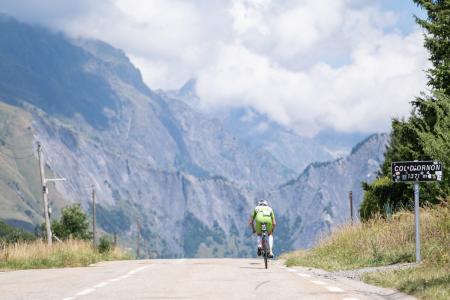
Goal: Prepare your legs and cardiovascular system for the long climbs of the triathlon. Develop your ability to sustain a strong effort on ascents (typical of race climbs).
Execution Tips: Ideally, find a climb with a 4–6 % gradient. Manage your effort: start each repetition slightly below your Zone 2 and gradually increase to the upper end of Zone 3. Stay seated as much as possible to conserve energy. Cadence: 70–80 rpm. On the descent, recover actively (don’t remain static). Nutrition: 1 gel or bar before the repetition block.
Perceived Intensity: Sustained but controlled effort. Breathing is deeper but steady; you can speak in short phrases. Thighs gradually feel warmer. The first two repetitions are manageable, while the last ones require mental focus. At the end of each climb, a slight muscular burn is normal.
Detailed Breakdown
0–20 min: Gradual warm-up on flat/slight inclines, finishing with 2–3 × 30 sec accelerations
25–90 min: Main block
1st climb: 10 min at 80–82 % max heart rate (easy start)
Descent recovery: 5–7 min
2nd climb: 12 min at 82–85 % max heart rate
Descent recovery
3rd climb: 15 min at 83–86 % max heart rate
4th & 5th climbs (if condition allows): 10–12 min at 85–88 % max heart rate
15 min: Cool-down on flat terrain, easy Zone 1–2
Total Duration: 2–2.5 hours depending on 3 or 5 repetitions
SESSION 3
HILL STRENGTH
Warm-up: 25 min
Main Sets: 6–8 × 3–5 min on steep climbs (7–10 % gradient)
Cadence: Low (50–60 rpm), seated
Intensity: Zone 4 – 85–90 % max heart rate
Recovery: 3–4 min descent
Cool-down: 15 min
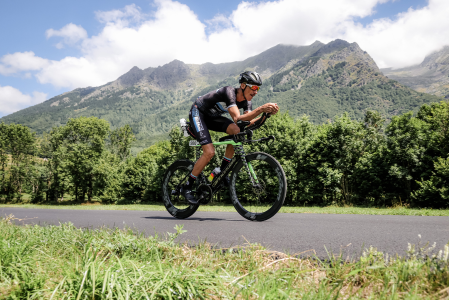
Goal: Develop specific muscular strength and pedaling torque. Strengthen quadriceps, glutes, and calves to be explosive on steep climbs. Improve pedaling efficiency at low cadence.
Execution Tips: Choose a short, steep climb (1–2 km). Crucial: stay seated on the saddle, do not pull on the handlebars. Push hard with your legs, maintain a smooth circular pedal stroke. Cadence: 50–60 rpm maximum—slow! Use a high gear, but not the heaviest, so you can maintain 50 rpm. During recovery, descend very easily and relax your legs. Ensure a proper warm-up to avoid injury.
Perceived Intensity: Very intense muscular effort. Legs feel strong, like a strength-training session. Breathing is deep, but the effort is more muscular than cardiovascular. Quadriceps burn starts around the 2nd minute of each repetition. Muscular fatigue builds with each repetition. It’s tough, but manageable!
Detailed Breakdown
0–25 min: Gradual warm-up, Zone 1–2
15 min easy
5 min tempo, Zone 3
3 × 1 min high cadence (100+ rpm) with 2 min easy between
30–75 min: Strength block (6–8 repetitions)
2 × 3 min in strength mode (adaptation) / recovery: 3–4 min descent + 1 min on flat
2 × 4 min in strength mode (main set) / recovery: 3–4 min descent + 1 min on flat
2 × 3–5 min depending on feel / recovery: 3–4 min descent + 1 min on flat
15 min: Cool-down, Zone 1, legs relaxed, normal cadence
Total Duration: 1 h 45 min – 2 h
SESSION 4
HIGH-INTENSITY ACCELERATION
Échauffement : 20 min
4-6 x 3min en montée régulière (4-6%)
Zone 5-6 (seuil-PMA) – 90-100% FCM
Récup : descente facile
Retour au calme : 15 min
Goal: Develop your ability to produce repeated high-intensity efforts, like attacks or accelerations during a race. Improve your VO₂max and anaerobic threshold. Prepare your body for the intensity variations typical of a mountainous triathlon course (accelerations at the base of climbs, overtaking, steep sections out of the saddle).
Execution Tips: Very demanding session—schedule it after a rest day. A long, gradual warm-up is essential to avoid injury. For each 3 min repetition, increase intensity progressively (don’t go all-out from the first second). Stay seated as much as possible to conserve energy. During recovery, pedal lightly on descents—don’t remain static. Stay well hydrated between repetitions. Limit to 4 repetitions if it’s your first session of this type; increase to 6 as you become comfortable.
Perceived Intensity: Extremely intense, near the limit of your capacity. Breathing is heavy and deep; talking is impossible. Strong thigh burn begins around 1 min 30 sec of each repetition. You’ll feel “red” in the last 30 seconds. Heart rate very high—you can feel your heart pounding. Between repetitions, full recovery is essential. Mental fatigue is significant, as each repetition requires maximum effort. After the session, you’ll feel like you gave everything.
Detailed Breakdown
0–30 min: Warm-up
0–10 min: Zone 1 very easy (50–60 % max heart rate)
10–15 min: Zone 2 (65–75 % max heart rate)
15–18 min: 3 × 30 sec at 85 % max heart rate / 30 sec recovery
18–30 min: Easy Zone 1–2 before the main block
25–70 min: Main Block (4–6 repetitions)
Structure of each 3 min repetition:0–30 sec: Progressive ramp-up 85 → 90 % max heart rate
30 sec–2 min: Stabilize at 90–95 % max heart rate
2–3 min: Final push 95–100 % max heart rate
Repetitions:
3 min – introduction to effort / Recovery: 4–5 min easy descent
3 min – push a little higher / Recovery: 4–5 min
3 min – into the hard zone / Recovery: 4–5 min
3 min – maximum concentration / Recovery: 4–5 min
Optional (if condition allows): 3 min / Recovery: 4–5 min
Optional (for experienced athletes): 3 min – final push!
15 min: Cool-down
0–10 min: Zone 1 very easy (50–60 % max heart rate), lactate clearance
10–15 min: High cadence, easy (95+ rpm) to relax legs
Total Duration: 1 h 30 min – 2 h depending on 4 or 6 repetitions
Precautions:
Do not perform this session if you are fatigued
Space it 3–4 days away from another intense session
Maximum once per week
Stop immediately if unusual pain occurs
Prefer 4 well-executed repetitions over 6 mediocre ones

SESSION 5
LONG RIDE
Duration: 4 h
Goal: Test the energy products you plan to use on race day
Route: Slightly hilly, ideally with 1,000 m elevation gain
Intensity: Zone 2 on flat terrain, up to Zone 3 on climbs – 65–80 % max heart rate
Goal: This is a key session for specific preparation. Get your body accustomed to long-duration effort, fully test your race-day nutrition strategy, and validate your ability to sustain 4 hours of effort. Think of it as a full dress rehearsal.
Execution Tips: Nutrition is crucial—test exactly what you’ll eat on race day (brands, flavors, timing). Plan 60–90 g of carbohydrates per hour starting from the second hour. Record everything you consume and note any digestive sensations. Hydration: 500–750 ml/hour. Start early in the morning, either fasted or after a light breakfast (as on race day). Arrange for feed stations or carry everything with you. Clothing: race-day gear. If possible, ride with a partner for safety.
Perceived Intensity: Endurance effort, mostly comfortable (Zone 2) with some harder sections (Zone 3) on climbs. The first 2 hours should feel easy, almost too easy. From 2 h 30–3 h, gradual muscular fatigue in the thighs. By 3 h 30, general fatigue begins—this is normal. The final kilometers can feel mentally long. You finish tired but not exhausted, still able to run 15–20 minutes afterward.
Detailed Breakdown
0–30 min: Very gradual start (Zone 1–2)
Full joint warm-up
Equipment check and body sensations
30 min–1 h: Settling into rhythm (Zone 2, 70–75 % max heart rate)
Stable cadence: 85–90 rpm
First nutrition intake at 45 min (bar/gel)
1–2 h: Cruise pace (Zone 2)
On climbs, let heart rate rise naturally to Zone 2–3 without forcing
Nutrition: gel or bar at 1 h 15 and 1 h 45
Hydrate regularly
2–3 h: Sustained effort
Pay close attention to nutrition (gel/bar every 30–40 min)
On climbs, accept heart rate in Zone 3 (75–80 % max HR)
Monitor digestive sensations
3–3 h 30: Key phase – fatigue management
Focus on cadence and position
Nutrition is crucial—do not skip any intake
Mental: stay positive; this simulates the end of the race
3 h 30–4 h: Final phase
Climb: gradually reach up to 80 % max HR
Last 10 min: slightly progressive pace as if approaching the bike transition
Last nutrition intake at 3 h 45
Post-Session:
Immediately note digestive sensations and what worked or didn’t in your nutrition
Active recovery: 15–20 min walk or very light jog
Recovery meal within 30 min
Total Duration: 4 h exactly