

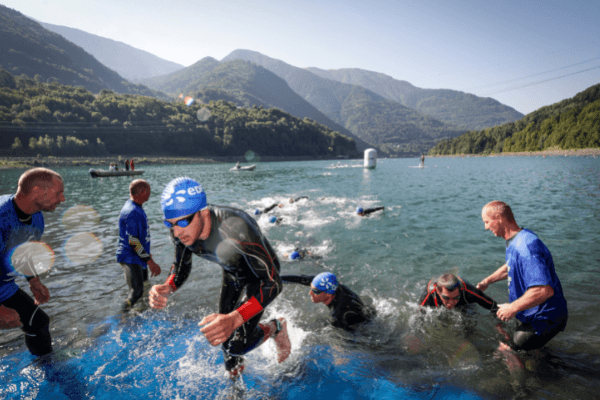
It’s a clear: the 15th edition of the Alpe d’Huez Triathlon 2021 is bound to be different, for the organisation team as well as for the participants who have faced all the difficulties to prepare themselves for such a challenge. The swimming, while the pools have just reopened their doors in France, brings out the fears of many triathletes. It is therefore the perfect opportunity to ask our partner GUTAÏ for an essential triathlon coaching session. Noémie Aupart, GUTAÏ coach, talks about the sudden resumption of training as well as the psychological management of the Alpe d’Huez Triathlon swimming.
How to approach swimming after 1 and a half years of pool closures?
“2020 and 2021 will have been complicated years to progress in the water or even to maintain your level. I imagine that for some people there is a strong apprehension because of the fact of imagining to swim almost 3/4 of an hour without feeling ready.
The good news is that the pools reopened for the public. Moreover, the good weather is here and the open water spots become accessible.
What you should do for the next 6 weeks :
- resume progressively while avoiding injuries. Indeed, after so much time without swimming your body will need to adapt to this effort. Start with sessions of 1200-1500m at the beginning then increase from 200m to 300m per session.
- Give preference to 2 technical sessions per week. The loss of aquatic sensations is the first cause of a strong regression in the water. Do not try to swim fast, learn to swim slowly with good support, buoyancy and coordination. Start with support and buoyancy training. You will see that very quickly the sensations will come back.
- Add 1 to 2 endurance sessions. Considering the distance and the format, doing high intensity sets will not bring anything in the short term. After a long break, the muscle strength disappears at 10% after 3 weeks and 30% after 6 weeks. This muscular strength is essential to progress in open water. I therefore advise you, after a gradual recovery, to swim in the pool for long series of 800 to 1000m continuously with Pullboy, concentrating on the tempo (cadence and rhythm of the arm/leg movement) so that it is as regular as possible. If you can, add an open water session in the form of fartlek.
Open water fartlek session example :
Duration = 1h
Warm up = 12min
Part 1 x 8
- INTENSITY 2 = 3min
just above the aerobic threshold, critical intensity
- INTENSITY 1 = 2min
fundamental endurance zone, below the aerobic threshold
- INTENSITY 3 = 1min
aerobic zone, above the aerobic threshold
In conclusion, my advice is :
- Start again progressively over 2 weeks by increasing the distances at each session by 10% maximum
- Include 2 technical sessions of less than an hour to improve your sensations
- Swim long sets of more than 800m to quickly increase your muscle strength.
- If you can, swim in open water to get as close as possible to the conditions of the event.
"Don't try to swim fast, instead learn to swim slowly with good stroke, flotation and coordination."
Noémie Aupart - GUTAÏ Tweet
How to prepare physically and mentally to face the Alpe d'Huez Triathlon swim?
Certain techniques allow us to face the external aggressions that upset our body, such as the cold. For example, conscious breathing, repeated exposure to the cold or mental concentration.In this respect, the Wim Hof method (named after its inventor) is interesting. It combines traditional breathing techniques with gentle movements and cold exposure training, the objective being to feel healthier and perform better. This breathing method is inspired by the meditation practice of Tibetan monks, aiming to raise the internal temperature of the body and control stress. It causes an excessive stimulation of the sympathetic nervous system, which is responsible for the increase of the heart rate, the increase of the blood pressure, the body temperature and the basal metabolism as well as the increase of the respiratory capacity. This method has been studied scientifically for a long time through the crazy records achieved by its author: running the marathon under -20°C or on the other hand achieving 50km of running in the desert without drinking… I invite you to consult the wim hof channel where you will find examples of breathing exercises. YOUTUBE WIM HOF
After mastering the breathing exercises, you can start exposing yourself to the cold gradually until you increase the duration or intensity of the cold. Start with a cold shower of 1min or 30s and then gradually increase to 5min. As soon as this step is mastered, you can move on to the cold bath. The number one rule is to listen to your body’s signals. Do not try to exceed your limits as a beginner. As soon as the sensations become unpleasant, stop the exposure.The main benefit is the increase in fat burning, especially white fat and the increase in basal metabolic rate through the accumulation of brown adipose tissue, responsible for thermogenesis (heat production by the body).
This experience allows a better management of stress and can also help you also help you to apprehend the start of a mass start or even to overcome your phobia of water phobia. To discover and test the method in “I’m a beginner” mode, here is a first guide: WIM HOF for beginners
Have a nice experience!”
In summary, the main benefits of the Wim Hof breathing method are as follows:
- Stimulation of the sympathetic nervous system
- Reduction of oxidative stress
- Improvement of sleep
- Strengthening of the immune system through the release of anti-inflammatory adrenaline and an increase in leukocytes
- Improved recovery through better blood circulation
- Better management of the race by reducing stress and increasing concentration

Noémie Aupart is a Gutaï coach, a sports physiotherapist and a specialist in energetic treatments.
“Thanks to a complete sport health and well-being follow-up, I accompany athletes in the achievement of their goals, through an individual and tailor-made care. “
Training plans GUTAÏ
Take advantage of the most popular triathlon training method right now to tackle the Alpe d’Huez 21 bends.