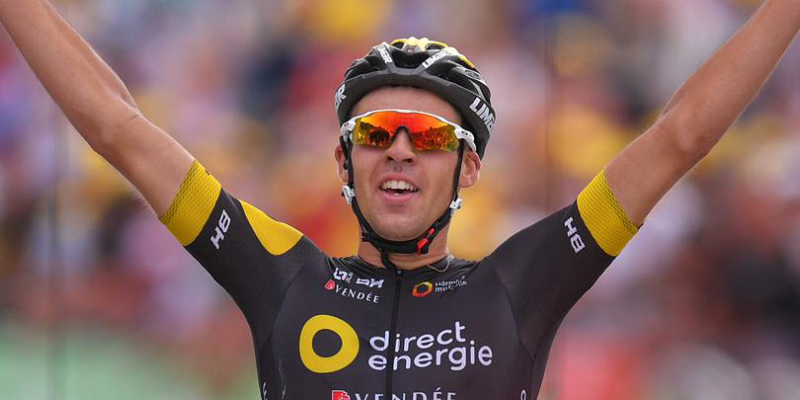
Lilian Calmejane, a former professionnal cyclist, Tour de France stage winner, who retired last autumn, will be at the start of the Alpe d’Huez Triathlon L on wednesday 30 July. Interview.
After a career in road cycling, you decided to try your hand at triathlon. Why this choice?
“Triathlon has been on my mind for some time now, even though I have no idea what swimming is. The two sports I enjoy most are cycling and running. I have to admit that part of me is completely addicted to sport. I really need sport in my life balance and to push my limits, whether in terms of endurance or difficulty. Now, combining cycling, running and swimming into one event raises triathlon up the list of the hardest sports. I’ve never taken part in a triathlon, but the desire to do so is very strong. The desire to transcend myself and take on a great challenge, and also the desire to discover and progress with each training session. Triathlon seems to me to be a sport that doesn’t bore you and that allows you to improve from season to season.”
Do certain triathletes inspire you or arouse your admiration?
“Although I’m not really involved in the triathlon world, I’ve had the opportunity to follow and work alongside some of them, in particular Vincent Luis. He’s a boy who has shown longevity, which is the most complex parameter at a high level. He has managed to stay at the top level for many years and remain the best French triathlete in the Olympic format. I really admire him for that, because as well as being talented, he’s a hard worker. For me, he really is one of the emblematic figures of triathlon in France and around the world.”

How did you choose to take part in the Alpe d'Huez Triathlon? Did the legend of the 21 bends contribute to your choice?
“Alpe d’Huez is a legendary climb. This triathlon was a natural choice for me. I’m very enthusiastic and I can’t wait to get to the start line. The memories I have of the 21 bends are precisely that the bends feel good: there’s a little flat spot each time, and then the slope straightens out again. It’s a fairly short climb where you can put your energy and pace into it without the risk of getting a big kick out of it. But it’s a very difficult climb because it can get very hot in summer. Imagining it after the swim and at the end of the bike course will make the 21 bends even more testing, rather like the finish of a stage in the Tour de France. Reaching the top is always a reward!”
What are your ambitions for your first triathlon season? What's your programme?
“I’m starting the season with my first two Half on the Ironman label in the amateur category, then I’ll switch over to events like Alpe d’Huez, Gérardmer and the Ventoux Man in the pro category during the summer. I don’t yet know whether I’ll be joining a club, so I’m giving myself time to make that decision. My transition from cycling to triathlon has already begun with a substantial running schedule. I’m gradually increasing the volume on foot to avoid injury and to work on my legs. Even if my physical capacities are there, running is a much more traumatic sport than cycling, so it remains a more complicated discipline for a cyclist. As soon as the weather’s fine, I’ll start cycling again to maintain my strengths. As for swimming, I’m going to try to learn as much as possible, to be OK in the water… but I’m not a dolphin! The main aim will be to survive swimming. I’ll have to work two or three times a week in the pool with a coach. But the idea is really to enjoy doing sport, as I’ve often done, but with fewer constraints.”
You'll be facing a special challenge at the Alpe d'Huez Triathlon: a 118km individual bike time trial. How are you approaching this unprecedented challenge?
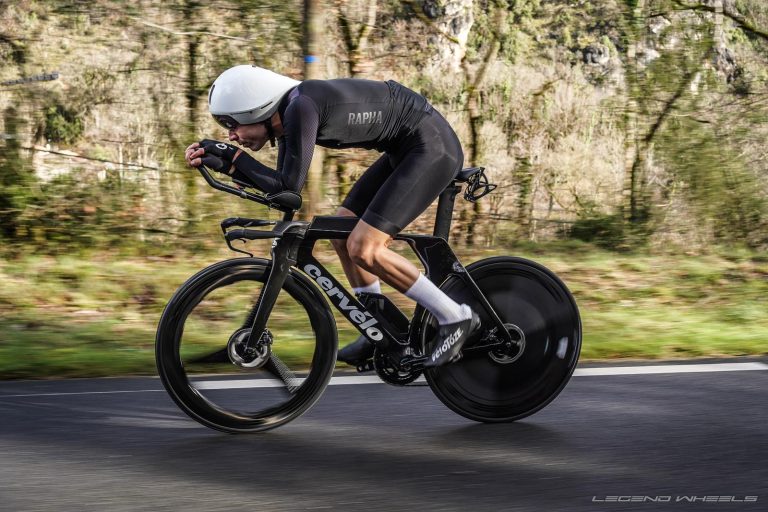
“It’s going to be a completely new challenge for me. In training, though, I’ve often worked with the time trial bike and done outings that could last up to 3 hours. In the end, that’s almost the same as the effort required for a Half Ironman. Having said that, the Alpe d’Huez bike course will be difficult to complete in 3 hours, because with its 118 km, that would mean an average speed of 42 km/h! Instead, there will be 4 hours of cycling and a choice of equipment to make. Will we need a road bike with extenders? A lightweight bike, a triathlon bike, a time trial bike? Solid wheels or not? These choices will come naturally when the time comes. I’m planning to come at least 4 or 5 days in advance, with my family, to spend some beautiful days in the mountains. I’ve also planned to do the climb up of the Alpe with two different bikes, at a very specific power, to get a feel for the differences between a triathlon bike and a road bike. However, I think it might be worthwhile fitting the lightweight road bike – it weighs 7kg – with extenders.”